Most companies don’t have a shortage of ideas. They have a sequencing problem. First comes the channel, the campaign, the format, the pressure to “post something”, “generate leads”, “turn on performance”. Only then does the real question appear: “Hold on, what are we actually trying to achieve and show the world?”
At Oleksy&Co, we say it plainly: Strategy before tactics. Context before action.
The context-first method starts with self-awareness. Not the soft version of “let’s explore our values” as an exercise. The hard benefit is this: a company that understands itself makes better strategic decisions because it can choose and it can say no. Strategy, in the classic sense, is built on choices and trade-offs, on what we decide not to do.
Why marketing without self-awareness turns into randomness?
If a brand has no clear identity, every tactic starts “creating” it by accident. Social media becomes the company’s personality. A sales deck becomes the brand promise. A new landing page becomes positioning.
That leads to drift: each piece of communication says something slightly different because it was created at a different time, under a different pressure.
This is the first rule of context-first: before you communicate anything, decide who you are as an organization, where you truly want to play, and why anyone should believe you. That’s the starting point for coherence and cost efficiency. You stop “testing everything” and start testing what actually fits the direction.
Self-awareness is also a condition for good leadership and better team decisions. When you see yourself more clearly, the quality of decisions, communication, and relationships goes up. In marketing, that translates into something very concrete: less chaos in priorities and fewer random pivots.
What does “context” mean in the context-first method?
Context is not just “market and competition”. In practice, there are at least five layers you need to put in order before you build a strategy:
- Business context: revenue model, margins, sales cycle, operational constraints, resources.
- Organizational context: culture, decision-making patterns, real readiness for change. Strategy provides the formal logic of goals. Culture translates them into daily behaviors. If the two collide, the plan stays a PDF.
- Brand context: identity, reputation, experience consistency, “what we truly promise and actually deliver”.
- Customer context: jobs to be done, risks, motivations, decision criteria (not just demographics). Jobs to be Done is useful because it shifts the conversation from “who the customer is” to “why they choose”.
- Market context: segments, competitors, substitutes, category dynamics, regulatory environment, trends.
The context-first method doesn’t remove classic tools. It puts them in the right order. First meaning and identity, then strategic choices, and only then execution.
Brand self-awareness: what it really means?
In branding, it’s easy to confuse two things: brand identity and brand image. Identity is what a brand decides to mean and consistently build. Image is what people actually think based on their experience with the brand.
The difference matters because strategy starts with decisions on the organization’s side, not with guessing what will “land”.
Two practical tools that help translate “self-awareness” into a working language:
- Kapferer’s Brand Identity Prism: organizes identity into six dimensions, combining internal and external elements. It prompts the right questions about culture, the relationship with the audience, and the consistency of how the brand looks, speaks, and behaves.
- Aaker’s model: distinguishes core identity (stable) from extended identity (flexible), which is useful when a brand grows, launches new products, or enters new markets.
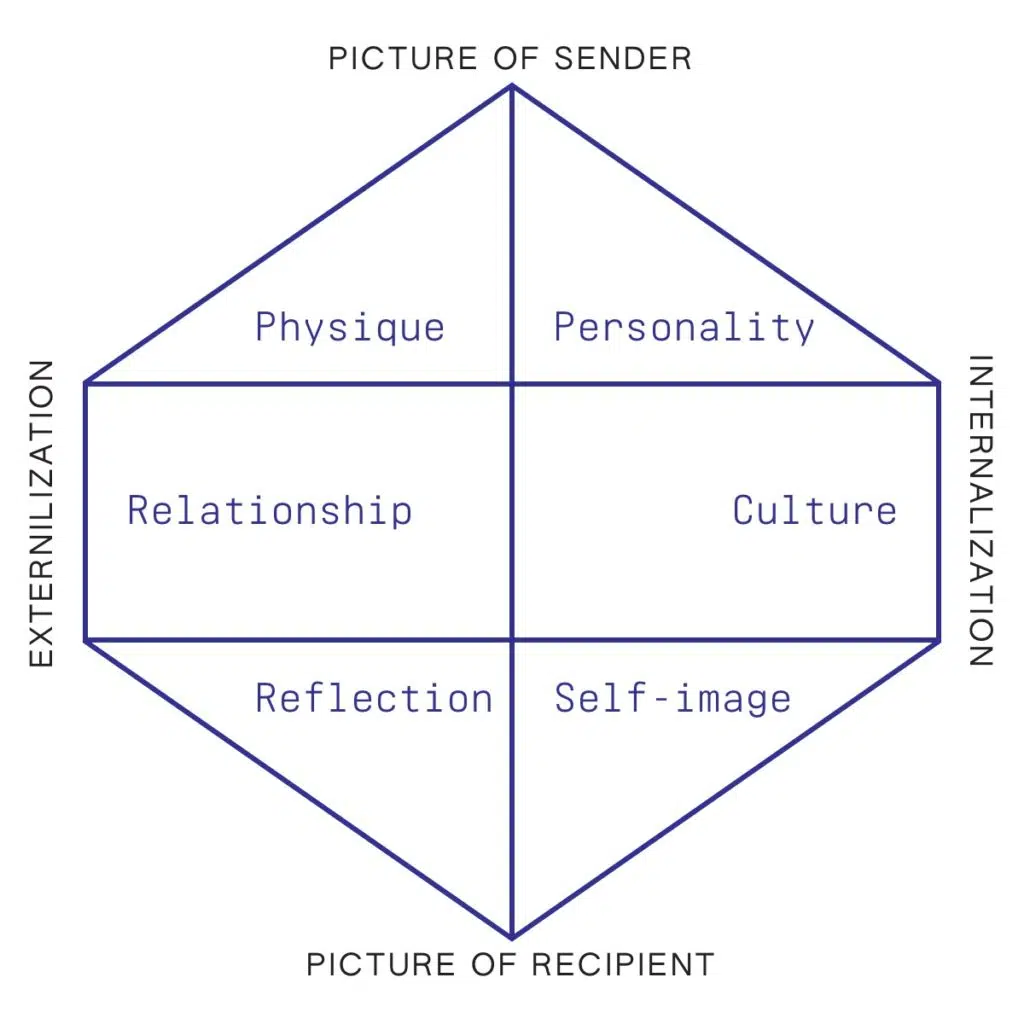
The point is not to “draw the prism”. The point is to build a shared decision language: what is core, what we protect, and what is just a communication tactic.
How self-awareness becomes strategy? The 6-step method
Step 1: Pause and write down the real starting point
Before you jump into “where we’re going”, name “where we are”. What are the results, where resources leak, what works, and what is just noise. This is the moment for a brutally simple audit, not a presentation.
Step 2: Define your core identity
Three elements are enough, but they have to be true:
- why we exist (meaning and value promise),
- what we are genuinely good at (capabilities, advantages, evidence),
- how we operate (style, principles, culture, boundaries).
If this part is vague or wishful, the rest will be wishful too.
Step 3: Choose your segments and decide who you say no to
STP still works, as long as you don’t do it “for a campaign” but for a growth direction. Segmentation, targeting, and positioning are tools for making choices, not tools for creating pretty personas.
A practical test: can you say who is not your customer over the next 12 months?
Step 4: Build positioning as a decision, not a slogan
Positioning happens in your audience’s mind, whether you work on it or not. Your job is to influence that perception deliberately, not hope it will “sort itself out”.
A simple structure works well:
For whom? (segment)
In what situation? (context, job)
What’s the promise? (value)
Why should they believe it? (evidence)
What do we exclude? (trade-off)
Step 5: Only now move to tactics and channels
This is where common sense returns: channels are a consequence of strategy, not the other way around. If your value proposition and proof are blurry, every platform will feel “expensive” and every lead will feel “weak”.
Step 6: Set measures that validate direction, not just activity
Strategy needs metrics that show progress in building position, not just clicks. Depending on the business model, the indicators will differ, but the principle stays the same: measure what confirms your strategic choices.
Three common traps the context-first method helps you avoid:
Trap 1: “Let’s do the communication, we’ll refine strategy later”
That almost always ends with rewriting the messaging every quarter. The issue isn’t copy. It’s missing decisions.
Trap 2: “Our advantage is quality and service”
That may be true, but it’s rarely distinctive without specifics and evidence. Context-first forces precision: what quality, in what area, compared to whom, for which customer.
Trap 3: “We do everything because we don’t want to miss opportunities”
That’s a classic anti-pattern. If you don’t choose, chance will choose for you, usually in the form of current noise and the loudest voices in the organization. Strategy is there to protect resources from chaos.
A mini exercise: 45 minutes that often changes more than the next campaign
Do it with 2-4 people. One sheet of paper. No slides.
- What single business change do we want to achieve in 6-12 months?
- What price are we paying today for lack of clarity (time, budget, frustration, lost opportunities)?
- What is our core that we do not negotiate?
- Who do we not help and why?
- How do we want to be chosen in the customer’s mind?
- What three proofs do we need for this promise to be credible?
- What actions are we cutting for the next 90 days?
If after this exercise you still feel that “everything matters”, you haven’t reached the real context yet. Go back to the business and organizational layers before you change communication again.
To close: why this matters?
This article has a simple goal: to show that good marketing starts with “who you are” before you start communicating. This approach isn’t trendy. It’s useful. It creates coherence, saves resources, and makes choices easier.
If you want, we can walk through this as a short context-first audit: what’s core, where the contradictions are, and which strategic decisions will unblock execution. Our work always starts with conversation and a real understanding of context.